“I am Georgian, and therefore I am European.”
Almost every Georgian knows this sentence. Zurab Zhvania, then Speaker of the Georgian Parliament, said it before the Council of Europe when newly independent Georgia joined the organisation.
I was still a child, but I do not remember ever questioning it. Raised in the Christian tradition, I understood the things I valued as part of a European inheritance. I assumed that inheritance was also mine.
The question came later, and from a direction I had not expected.
I was in the United States, showing a classmate where Georgia was on a map, when he asked, with genuine concern, whether it was difficult to live so close to a war zone. I was confused until I realised he meant Iraq.
The misunderstanding startled me. For the first time, I thought about Georgia not in terms of belonging, but simply as a point on a map. And my classmate was not entirely wrong about the distances. The East is not far from us. Some Middle Eastern capitals are closer to Tbilisi than a number of European ones.
And yet the map had never told me who I was. It had never crossed my mind which of these civilisations I belonged to, because belonging, I have come to believe, is not measured in miles. It is measured in what you love, what you hold sacred, and what you are willing to defend.
All of which is to say that this summer I travelled to the United Kingdom for the very first time and I cannot imagine a gentler or more fitting introduction than the one I was given. It came as a gift from my husband, the true devotee of Roger Scruton in our household, who could not bear to keep to himself a week he knew would move me — though I suspect he may now struggle to find anything comparable for my next birthday.
Scrutopia began in a home. Sophie and Lucy welcomed us into the place and the world that had grown around Roger Scruton. Opening something so bound up with family life to a group of strangers must involve a degree of courage. They did it with such warmth that, from the first afternoon, I felt less like a participant on a course and more like a guest.
The theme they set before us was civilisation itself: what it means to be civilised, what builds a civilisation and what unmakes one, and how, in each generation, we decide what to keep, what to reform, and what to let go.
It is tempting to speak of civilisation as though it were the natural condition of mankind, a floor beneath which we cannot fall. It is nothing of the kind. It is an achievement, drawn slowly out of disorder and held only for as long as people trouble to hold it less a possession than a trust, received from those who came before and owed to those not yet born. Those who live at the settled heart of a civilisation may take it for granted. Those of us who live on its frontier, where another order presses close, cannot afford to.
And what struck me, again and again, was that the whole texture of the week was quietly making this argument for us. There were the farm walks through the Cotswold country and the long afternoon teas; there was St Mary’s at Fairford, where a church has stood for roughly a thousand years and the present building still holds its extraordinary late-medieval stained glass light falling, century after century, through the same images. These were not decorative additions to an intellectual programme; they were part of the argument.
Civilisation has an outward form. It lives in manners, beauty, hospitality and memory in the patient care given to things one did not create and may never oneself enjoy, in the decision to preserve something simply because a world without it would be poorer.
Even the wine made the point.
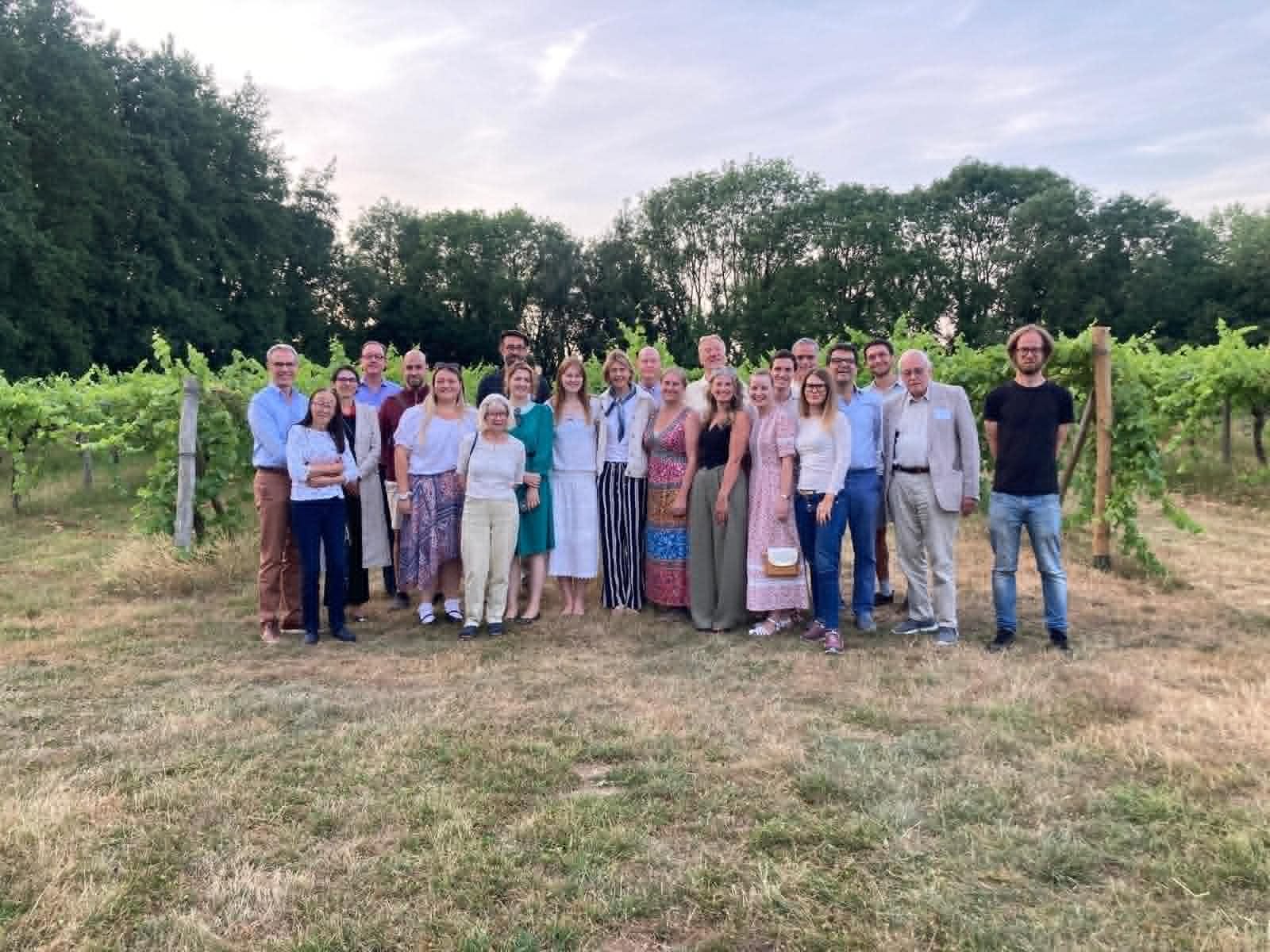
England has no ancient tradition of it, and that was precisely what moved me: at one small vineyard we tasted a wine made from the Bacchus grape by a family tending their vines not for commercial reward but as an idea, a legacy, a project worth undertaking because it was worth undertaking.
I come from one of the oldest wine cultures on earth Georgians have been making wine for some eight thousand years and there was something unexpectedly moving in encountering one of the youngest expressions of the same human impulse. To plant a vine from which you may never profit is, when you think of it, civilisation in miniature: an act of faith in a future you are helping to furnish for someone else. Wine, I confess, is the one inheritance I hold without hesitation deep, continuous, a source of uncomplicated pride. Other inheritances I am still searching for.
Chief among them is faith.
One Sunday we attended an Anglican service, and I was moved by the simplest things in it the music, the congregation gathered together, the coffee shared afterwards. At the end we were invited forward to receive communion, and I held back: partly from shyness, but partly because the very openness of the invitation was so unfamiliar to me. To be asked, simply, to come to the table would be almost unheard of in the church I know. Georgia is one of the oldest Christian nations in the world, and yet faith remains among the inheritances I am still trying to recover for under the long shadow of Russian and Soviet domination, the Church at home has too often been drawn toward fear and obedience: a punitive image of God enlisted to teach conformity with power, rather than the God of grace and welcome for whom I keep searching. To be quietly invited to step forward felt like its own small revelation.
The days themselves were devoted to the life of the mind, and the speaker who most captivated me was Georgios Varouxakis, whose The West: The History of an Idea was the first title I bought from the formidable reading list I brought home. His argument is that “the West” is a surprisingly recent invention, formed in the nineteenth century in part to mark western Europe off from the Russian empire that was coming to be seen as its rival — and that its meaning is being rewritten again in our own time, since 2022, around Ukraine. For most in the room this was intellectual history, a question to be debated. For a Georgian it was closer to the news.
And it threw into relief something I have never been able to share: the tenderness the West still keeps for another Russia: the Russia of Tolstoy and Dostoevsky, of the great ballet as though that Russia and the one at our border were the same country. They never were. The humane Russia of the novels never governed anyone; it was never the Russia the borderlands actually met. Those who have felt the empire on a cellular level find the romance hard to bear and find a certain vindication in being reminded that Europe first defined itself, in part, precisely against that power.
But the hours I will keep longest were the evenings — wine in hand, the talk running late and unhurried, disagreement met with curiosity rather than offence, with one memorable exception. It was, without anyone naming it so, the old form of the symposium restored: thought and wine and good company as a single art. One night I poured Georgian wine for the table and felt the two ends of a very long thread meet in my hands. And it was in that setting that our fiercest conversations took place — often, perhaps because of who I am and what I do, on the question of rights.
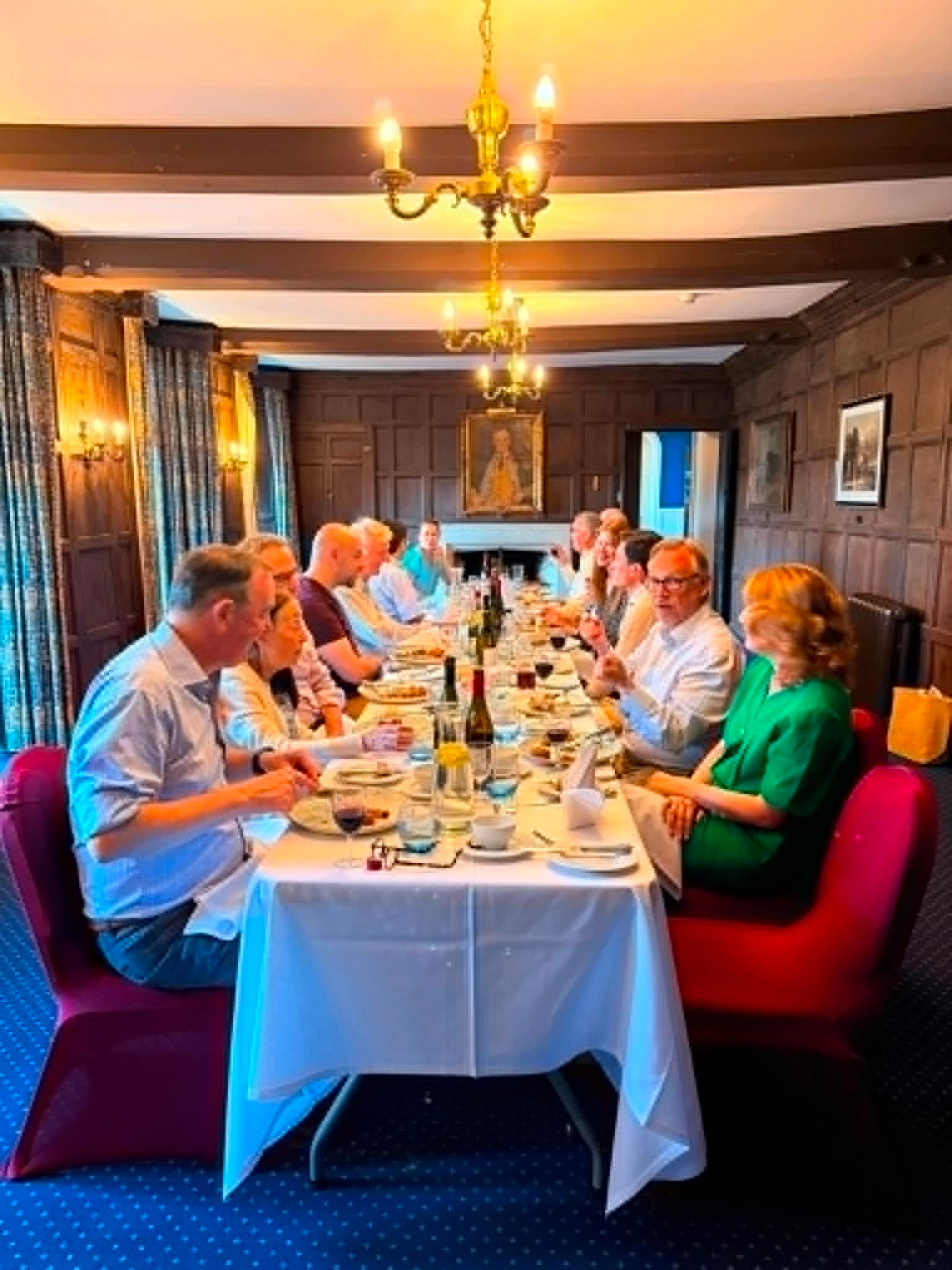
The unease I met was rarely hostility to human rights as such. More often it was a fear that the language of rights had floated free of the things that anchor it responsibility, reciprocity, borders, the inherited forms of life that let a community hold together at all. That fear should not be waved away. A civilisation is entitled to keep its laws and its character: to punish wrongdoing, and to ask those who arrive to respect the order they have chosen to join. To care about the continuity of one’s own home is not shameful, and universal dignity has never meant that every claim must be granted or every distinction dissolved.
But dignity is precisely what marks the limits within which those boundaries may be drawn. A person may be refused entry without being humiliated, a law enforced without cruelty, integration asked without demanding that every private difference be erased.
The task is never to choose between borders and compassion, but to hold the two together: hospitality without limit may not endure, yet limit without humanity is no longer civilised. This is why the language of rights remains indispensable — not because it can tell us how many to admit or who should be given a passport, but because it insists that even our hardest and most necessary decisions be made without denying the humanity of those they fall upon.
For if dignity means anything, it is that a person is owed respect for no reason other than that they are a person — in the Christian telling, because each of us bears the image of God; in the philosophy that grew from it, because a person is always an end and never merely a means to another’s purpose. A dignity of that kind cannot be rationed; made conditional on birth, on usefulness, on belonging to the right inheritance, it stops being dignity and becomes privilege. The principle was never that every person is entitled to everything. It was that no person is nothing.
And so the thing I found myself hungriest for, and most reluctant to leave behind, was the openness itself. This unhurried life of the mind the seminar, the argument, the wine, the willingness to be wrong in good company is something so many of us quietly lack and badly need. I am, or would like to believe I am, a classical liberal; I arrived among a largely conservative company half expecting to feel outnumbered, and found instead a room genuinely open to me. I came home more sure, not less, that classical liberalism still offers the most rational answers to a great many of our troubles. And though most of my fellow Scrutopians would gently dispute me, the sheer liveliness of that dispute was the only proof I needed that Western civilisation is not exhausted but alive — and, being alive, worth keeping.
I could not think about any of this without thinking of home. Georgia belongs to this inheritance through its faith, its literature, its long memory of Byzantium — as surely as any nation of the settled West. But we hold that belonging on a frontier, with another order pressing all around us.
For Georgia, Europe has never been a simple gift of geography. It has always been an act of will.
The West we admire with its own faults and deficiencies was never inevitable. Like Rome, it was not built in a day and it was not built only once. It was built again and again, by people who decided, in every generation, that beauty, memory, freedom, responsibility, truth and human dignity were worth the trouble of preserving. Nothing about it is given. To inherit a civilisation is not merely to receive its achievements; it is to accept the obligations that made those achievements possible to preserve what deserves preserving, to repair what has been damaged, and to pass the inheritance on without either closing it off entirely or giving it away so carelessly that nothing recognisable remains.
That, in the end, is what I now hear in Zhvania’s sentence. Not a description of where Georgia sits on a map, and not a claim to something earned by others that asks nothing of us. It is a declaration that this is the inheritance we choose — and that, in choosing it, we accept the duty to sustain it.